

Poodles come in more sizes and colors than many future owners realize. From the tiny Toy Poodle to the athletic Standard—and from classic black or white to red, silver, parti and phantom patterns—the choices can feel almost endless. This complete guide explains the official size systems, popular coat colors, how shades can change with age, and what matters more than appearance when choosing a puppy.
Although size changes the practical experience of living with a Poodle, every well-bred variety should retain the breed’s intelligence, elegance, active nature and close connection with people. Color adds beauty and individuality, but health, temperament and responsible breeding should always come first.
Poodle Sizes at a Glance
There is no single worldwide size system. The American Kennel Club (AKC) recognizes three varieties, while the Fédération Cynologique Internationale (FCI) recognizes four. Measurements are taken at the withers—the highest point of the shoulder blades—not at the top of the head.
| Variety | AKC Height | FCI Height | General Lifestyle Profile |
|---|---|---|---|
| Standard Poodle | Over 15 inches | Over 45 cm to 60 cm, with a limited tolerance above | Athletic, versatile and best for owners who enjoy an active, larger companion |
| Medium Poodle | Not a separate AKC variety | Over 35 cm to 45 cm | A balanced middle size recognized within the FCI system |
| Miniature Poodle | Over 10 inches and up to 15 inches | Over 28 cm to 35 cm | Compact, sporty and adaptable without being extremely small |
| Toy Poodle | 10 inches or under | Over 24 cm to 28 cm, with a small lower tolerance | Tiny, highly portable and suited to attentive homes that understand delicate-dog care |
Important: “Moyen” is commonly used for the Medium Poodle, especially in international conversations. It is an official size under the FCI standard, but it is not a separate AKC variety. Always ask which registry and measurement system a seller is using.
Standard Poodle: The Largest Variety
The Standard Poodle is the original large, athletic expression of the breed. Under the AKC system, any correctly proportioned Poodle standing over 15 inches at the shoulder enters the Standard variety. The FCI gives a more defined range, placing Standards over 45 cm and up to 60 cm, with a limited tolerance above that maximum.
Standards need room to move, but they are not limited to large houses. A well-exercised, well-trained Standard can settle beautifully indoors. They often suit active families, dog-sport enthusiasts and owners who want a substantial companion for walking, training and outdoor adventures.
- Consider a Standard if: you want a larger, athletic dog and can provide daily exercise, training and regular coat care.
- Plan for: larger food portions, a bigger crate, higher grooming costs and more space during transport.
- Do not assume: that a larger Poodle is automatically calmer. Temperament, age, training and daily routine matter more than height alone.
Medium or Moyen Poodle: The International Middle Size
The current FCI standard recognizes the Medium Poodle at over 35 cm and up to 45 cm. This variety sits between the FCI Miniature and Standard. “Moyen” is simply the French word for medium and is widely used by breeders and owners, even though the official English FCI standard calls the variety Medium.
In countries using the AKC system, a Poodle in this height range is generally registered and shown as a Standard because it is over 15 inches. This does not mean the dog changes breed; it means the registries divide the same breed differently. Pedigree, registry, adult measurements and breeder records should be reviewed carefully whenever “Moyen” is advertised.
Miniature Poodle: Compact and Athletic
The AKC defines the Miniature Poodle as over 10 inches and no more than 15 inches at the shoulder. Under the FCI standard, the range is over 28 cm and up to 35 cm. Because the boundaries differ, a dog described as Miniature in one system may fall into a different variety in another.
Miniatures are often a practical choice for people who want the athletic energy and trainability of a Poodle in a compact body. They can enjoy agility, obedience, scent work, hiking and city life when their physical and mental needs are met.
- Good balance: easier to carry and house than a Standard, but generally more robust than a very small Toy.
- Daily needs: purposeful walks, games, training and regular interaction.
- Household fit: often suitable for apartments or family homes when barking, exercise and alone-time skills are managed thoughtfully.
Toy Poodle: The Smallest Recognized Variety
Under the AKC standard, a Toy Poodle stands 10 inches or under. The FCI describes Toys as over 24 cm up to 28 cm, with 25 cm sought as an ideal and a small tolerance below the lower boundary. Despite the tiny size, a correct Toy should still look like a balanced Poodle—not a dog selected for exaggerated dwarf-like features.
Toys are intelligent, lively and deeply people-oriented. Their portability makes them attractive to city residents and frequent travelers, but their small bodies require careful handling. Falls, rough play with larger dogs and unsupervised interaction with young children can cause injury.
For a detailed look at care, training and health, read our complete Toy Poodle puppy guide.
Are “Teacup,” “Micro” and “Tiny Toy” Official Sizes?
No. These are marketing labels, not additional Poodle varieties recognized by the AKC or FCI. They may be used informally to describe an unusually small Toy Poodle, but they do not create a new breed standard or guarantee an adult size.
When extreme smallness becomes the main selling point, ask more questions. Very tiny puppies can require more frequent feeding, closer monitoring and stricter protection from falls or rough handling. Choose a sound, active puppy with honest records rather than paying a premium for the smallest possible label.
Does Poodle Size Change Personality?
All Poodle varieties should share the breed’s intelligence, alert expression, trainability and proud carriage. Size influences exercise style, handling, housing and travel logistics, but it does not write the puppy’s entire personality.
Temperament is shaped by genetics, early development, socialization, training, environment and individual experience. A confident Toy can be adventurous, while a gentle Standard may be content to relax close to the family after exercise. Ask about the parents’ behavior and meet the puppy through a live video or in person whenever possible.
How to Choose the Right Poodle Size
- Consider safe handling: can every family member interact gently with a Toy, or would a larger, sturdier dog be more appropriate?
- Match your activity level: all sizes need enrichment, but a Standard usually requires more physical space and exercise volume.
- Budget for grooming: larger coats require more time and commonly cost more to maintain professionally.
- Plan transport carefully: crate size, airline options, route rules and cabin eligibility depend on the individual dog and carrier—not only the variety name.
- Verify expected size: review the measured height and weight of both parents, previous mature offspring when available and the puppy’s growth record.
The Poodle Color Palette
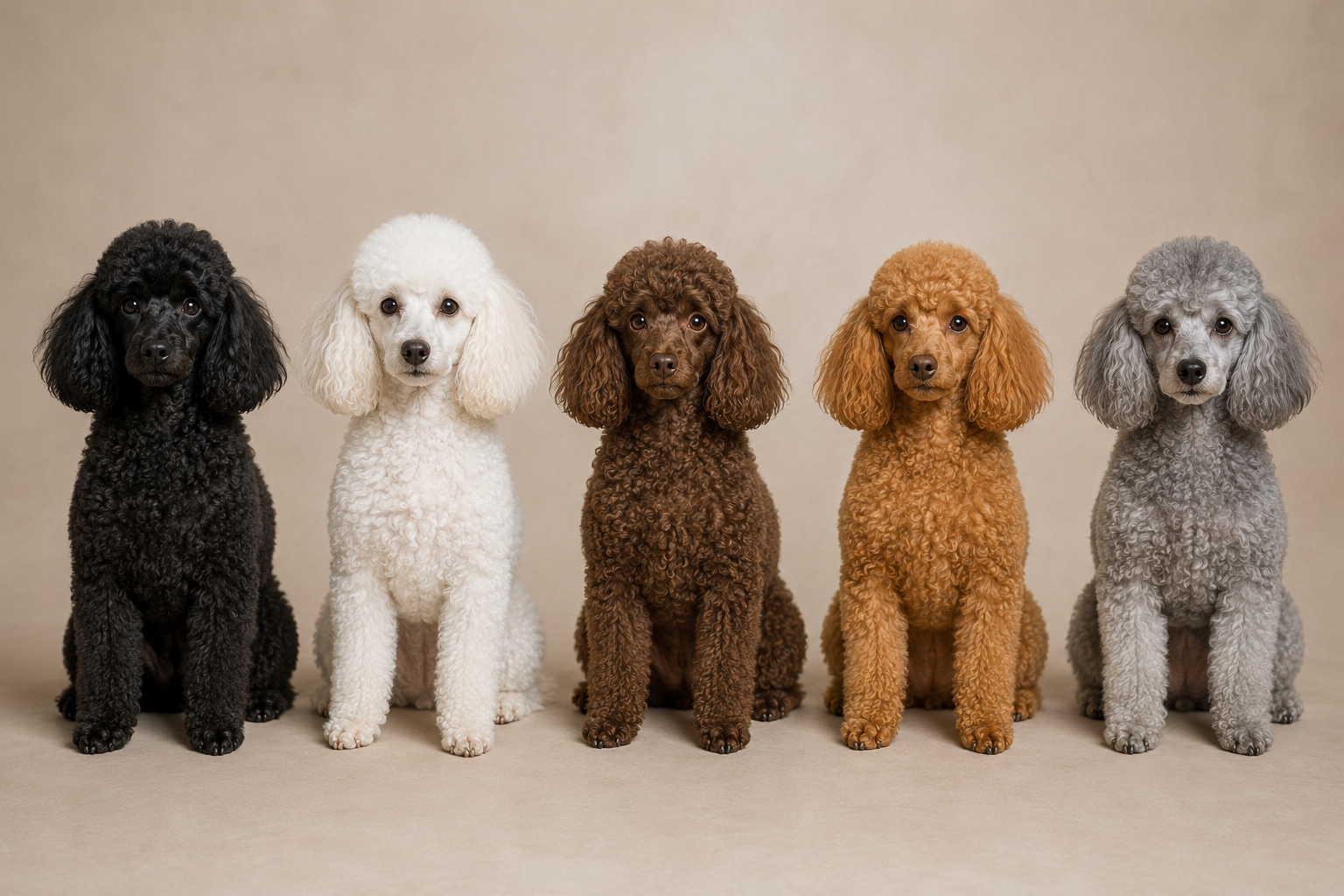
Poodles have one of the breed world’s most elegant color ranges. The AKC lists solid colors including black, white, brown, blue, gray, silver, cream, apricot, red, café-au-lait and silver beige. The AKC show standard expects an even solid color at the skin, while allowing natural variations of the same shade in several colors.
Black Poodles
A rich black Poodle has deep, even pigment and a dramatic glossy appearance when the coat is healthy. Sun exposure, age and genetics can influence how the coat looks over time. Ask to see adult relatives rather than relying only on puppy photos.
White and Cream Poodles
White and cream are separate color descriptions. White Poodles should have appropriate skin and nose pigmentation; they are not the same as dogs with albinism. Cream can range from nearly white to a soft warm ivory and may be easier to appreciate in natural daylight than under warm indoor lighting.
Brown, Café-au-Lait and Silver Beige
Brown Poodles are expected to carry brown-toned pigment on the nose, eye rims and lips. Café-au-lait and silver beige describe lighter or developing expressions within the brown family. Puppy color may evolve as the adult coat comes in, so documentation of the parents and older relatives can help set realistic expectations.
Apricot and Red Poodles
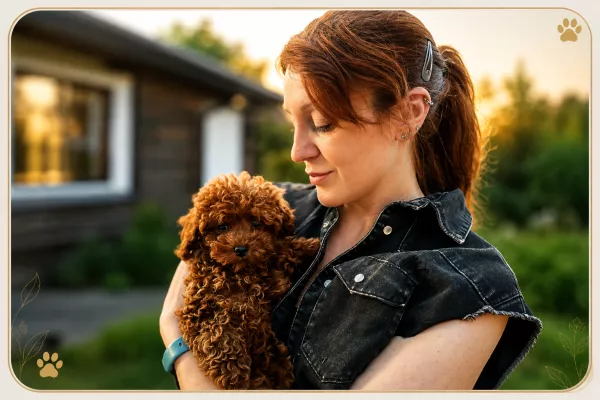
Apricot ranges from pale warm gold to deeper orange tones, while red describes a richer, more intense expression. These colors are especially popular, but photographs can be misleading: sunlight, filters, camera white balance and fresh grooming can all change the apparent shade.
Some red or apricot Poodles remain deep, while others lighten as they mature. No responsible source should guarantee that a young puppy will preserve an exact shade for life.
Blue, Gray and Silver Poodles
These cool-toned colors can develop gradually. A silver puppy may be born much darker and “clear” over time, often beginning around the face. Blue is generally deeper than silver, while gray covers a range of mature cool shades. Color development varies, so a puppy’s final appearance may not be obvious at eight or ten weeks.
Parti, Phantom and Other Multicolored Poodles
Registry rules matter here. Under the AKC conformation standard, a parti-colored coat—two or more colors rather than an even solid color—is a disqualification in the show ring. That rule does not automatically mean every parti Poodle is unhealthy or not purebred; it describes eligibility under that specific conformation standard.
The FCI standard valid from August 2024 recognizes several additional color presentations, including black-and-white, gray-and-white, fawn-and-white and brown-and-white parti combinations; black or brown with defined fawn points; tricolor; and brindle presentations. Therefore, claims such as “this pattern is recognized everywhere” or “this pattern is never recognized” are both too broad.
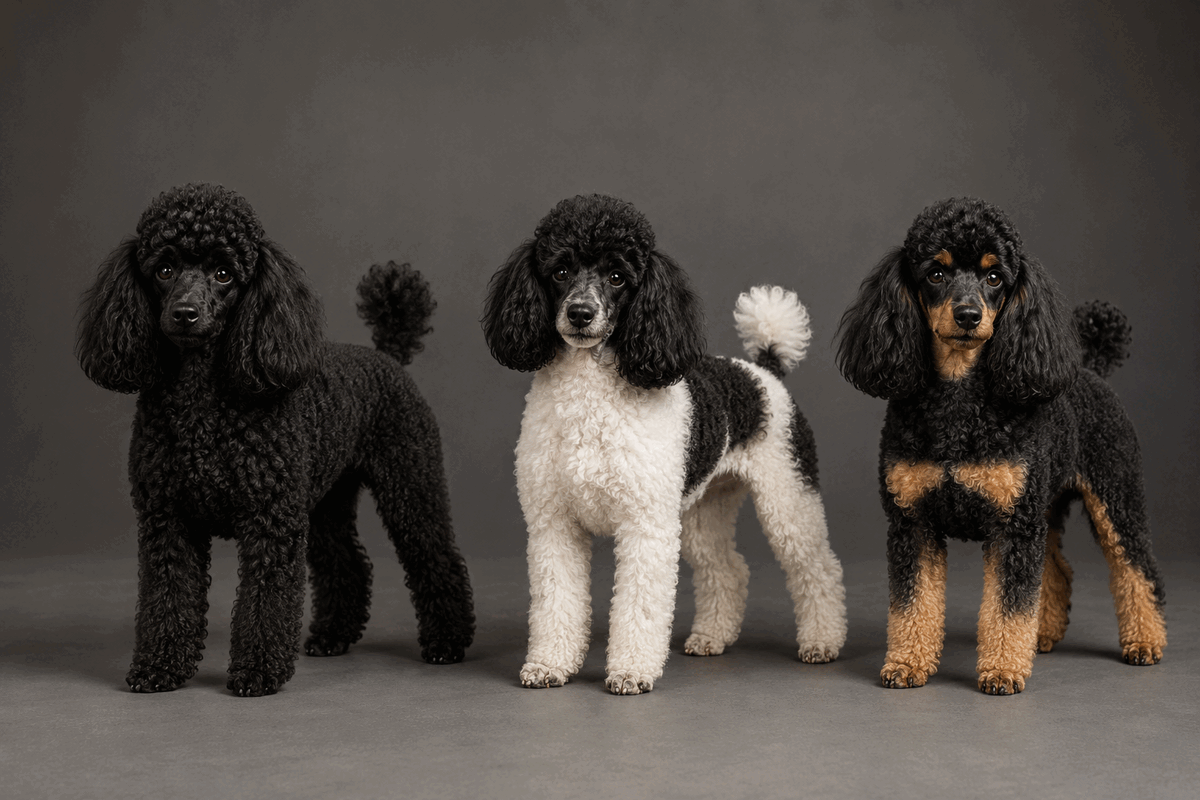
- Parti: two colors with significant white and colored areas.
- Phantom: a solid base with clearly positioned tan or fawn points, often above the eyes, on the muzzle, chest and legs.
- Brindle: darker striping over a lighter base, which may occur alone or with white under the current FCI description.
- Merle: not listed as a Poodle color in the official AKC/PCA or FCI standards cited in this guide. Any merle claim deserves careful pedigree, parentage and health scrutiny rather than a higher price based on rarity.
Why a Puppy’s Color May Change
The soft puppy coat is not the final adult coat. As Poodles mature, coat texture changes and some colors lighten or “clear.” The pace and degree are individual. Ears may remain darker, and natural shading within the same color can occur.
For the most realistic expectation, request:
- Current photos and video in neutral daylight without filters.
- Clear images of the coat at the skin, nose and eye-rim pigmentation.
- Photos of both parents as adults.
- Examples of older full siblings or previous offspring, when available.
- The registered color description and the registry that issued the pedigree.
Color Is Beautiful—Health Comes First
No coat color guarantees quality, and a fashionable shade cannot replace health screening. The Poodle Club of America recommends different tests by variety. Its December 2024 health statement includes PRA-prcd DNA testing, annual eye examinations and patella evaluation for Toys; those tests plus hip evaluation for Miniatures; and hip, eye, thyroid, NEwS and von Willebrand disease type I screening for Standards.
Health documents should be connected to the identified sire and dam and verified through the relevant database when possible. Ask what was tested, at what age, by which laboratory or specialist and whether the results are publicly recorded.
Premium puppy selection is not about finding the rarest label. It is about finding the right combination of health, temperament, structure, responsible care and an honest match for your family.
Questions to Ask Before Choosing a Poodle
- Which registry defines the puppy’s size and color description?
- What are the measured adult heights and weights of both parents?
- Can I see the parents’ pedigrees and breed-relevant health results?
- Has the puppy received an age-appropriate veterinary examination, vaccinations, deworming and microchip?
- Can I see an unedited live video of the puppy moving and interacting?
- Has the expected adult size or color been described as an estimate rather than a guarantee?
- What documents, supplies, handover support and travel arrangements are included?
Finding Your Poodle with 50 Dogs
Whether your preference is a tiny red Toy, a balanced Medium, an athletic black Standard or a beautifully patterned Poodle, the right choice begins with more than a photograph. Through the 50 Dogs Pet Order Service, our team can help coordinate puppy availability, breeder communication, documents and the practical steps needed to bring you closer to a suitable companion.
If you already have a Poodle who needs to travel, submit the route and pet details through our Pet Shipping Service. International travel depends on age, origin, destination, airline and current veterinary and import requirements, so every route must be reviewed individually before it is confirmed.
Frequently Asked Questions
What is the smallest official Poodle size?
The Toy is the smallest variety recognized by both the AKC and FCI. “Teacup” and “micro” are informal marketing labels, not additional official sizes.
Is the Moyen Poodle officially recognized?
Yes under the FCI system, where it is called the Medium Poodle and measures over 35 cm to 45 cm. It is not a separate AKC variety; an AKC Poodle over 15 inches is classified as Standard.
Which Poodle size is best for an apartment?
Toys and Miniatures are compact, but size alone does not determine apartment suitability. Exercise, mental enrichment, barking habits, training and the owner’s schedule matter. Even a Standard can live comfortably in an apartment with a suitable routine.
Do red and apricot Poodles fade?
Some lighten noticeably as they mature, while others retain a deeper shade. Genetics, age, coat change and lighting affect appearance, so an exact lifelong color should not be guaranteed.
Can a parti Poodle be purebred?
Yes, a Poodle can have documented purebred ancestry and a parti coat. However, conformation eligibility differs: the AKC show standard disqualifies parti color, while the current FCI standard recognizes several parti combinations.
Is one Poodle color healthier than another?
Color alone is not a reliable measure of overall health. Evaluate verified breed-relevant testing, pedigree, temperament, veterinary care and responsible breeding decisions rather than choosing by shade alone.
The Right Size, the Right Color, the Right Match
Poodles offer a rare combination of elegance, intelligence and variety. Their sizes can suit very different lifestyles, and their colors range from timeless solids to striking patterns. Understanding the registry behind each description helps you compare puppies accurately and avoid misleading labels.
Ready to look for your dream Poodle or arrange a safe journey for your pet? Start with our Pet Order Service or request support through our Pet Shipping Service.
50 Dogs — Become Closer To Your Dream Pet.
Sources and Professional Guidance
- Poodle Club of America: AKC Poodle Breed Standard
- American Kennel Club: Poodle Breed Information
- Fédération Cynologique Internationale: Poodle Standard No. 172, valid from August 1, 2024
- Poodle Club of America: Health Statement, December 11, 2024
This article provides general educational information. Registry rules, import requirements and veterinary recommendations can change. Confirm current requirements with the relevant registry, veterinarian, airline and destination authority.